Critical Thinking on Social Media – Is the Younger Generation Really Better at It than Everyone Else?
It is almost impossible to imagine modern life without the internet. Today, it has become an inseparable part of everyday life, with people relying on digital platforms for communication, work, education, entertainment, and access to information. However, the internet is not only a space full of opportunities and innovation—it has also become an environment where misinformation and fake news spread rapidly. More and more often, digital platforms are being used not simply for sharing information, but as tools for political influence, public manipulation, and shaping the opinions of millions of people around the world.
This raises an especially important question when we look at younger generations—Generation Z and Generation Alpha—who were born and raised in a digital world and have interacted with the internet from an early age as a natural part of life. This leads to an important question: are people who grew up in the era of social media, algorithms, and artificial intelligence actually better at recognizing misinformation than older generations? Or, on the contrary, does the constant flow of information, the rapid development of AI technologies, and increasingly sophisticated methods of digital influence make modern users even more vulnerable to manipulation and false information?
We have become used to assuming that young people are naturally better with technology and more comfortable navigating the digital world than older generations simply because they grew up fully immersed in it. However, information manipulation primarily targets people’s perception, emotions, and decision-making processes. It is clear that manipulating information on social media is far easier than through traditional editorial media. Social media has made it possible for anyone to publish content and freely express opinions. At the same time, this has significantly increased the risk of misinformation and many different forms of manipulation.
This is where critical thinking becomes essential. A 2025 report on source criticism in Sweden, Källkritik i Sverige 2025, shows that more than four out of ten respondents believe it is easy to determine whether information on social media is true or false. At the same time, roughly three out of ten people consider this process difficult. One of the clearest findings is that the older people are, the more challenging they find it to verify the credibility of information online.
The same report suggests that differences between age groups may partly be explained by the fact that younger people are generally more digitally active and more familiar with social media platforms. In addition, they are increasingly introduced to digital literacy and source evaluation in schools. At the same time, research shows that younger users often overestimate their own ability to critically evaluate online information. The strongest indicators of good critical thinking skills are not age alone, but rather a high level of education, regular engagement with news, and the habit of gathering information from multiple sources.
When it comes to critically analyzing online information, clear differences can be observed between younger and older internet users. Young people who grew up in the digital era usually adapt more quickly to new technologies, navigate modern online platforms more efficiently, and are generally better at identifying content created with artificial intelligence. In addition, members of Generation Z and Alpha increasingly receive basic education in digital safety, media literacy, and source verification through schools and universities, making them more systematic and detail-oriented when evaluating online content.
Older generations, however, often possess different but equally valuable strengths. Many adults have developed stronger analytical thinking through life experience, education, and professional backgrounds, allowing them to conduct deeper analysis, compare information from different sources, and evaluate credibility based not only on facts but also on personal knowledge and experience. Older internet users also tend to approach online information with greater skepticism and caution. In this sense, each generation has its own advantages in dealing with misinformation. Effective critical thinking depends less on age and more on digital literacy and the ability to consciously evaluate information.
Improving critical thinking online across different generations requires a comprehensive approach where education, intergenerational cooperation, and lifelong development of digital literacy all play a central role. First and foremost, the foundations of critical thinking must be established in schools through media literacy weeks, specialized educational projects, and systematic work focused on teaching students how to evaluate information sources. In today’s world, simply consuming information is no longer enough—people must understand who created the information, why it is being distributed, and whether it can be trusted.
For this reason, schools should not focus solely on teaching facts but must also develop the habit of questioning information, asking critical questions, and verifying sources. Educational initiatives that support teachers and help integrate critical thinking directly into the learning process are becoming increasingly important.
For younger generations, it is equally important to broaden perspectives and learn to recognize connections between global political, economic, social, cultural, and environmental processes. One promising approach is the concept of global education, which encourages young people to understand the world as a complex, interconnected system. Its goal is not to provide simple answers to difficult questions, but to help young people manage complexity, accept uncertainty, and understand that many modern problems do not have simple solutions.
Equally important is the principle of lifelong learning. Older generations need accessible programs that help develop digital skills, yet research shows that simply providing access to technology is not enough. The real challenge lies in building effective learning systems that allow individuals to confidently and independently use new digital tools in everyday life.
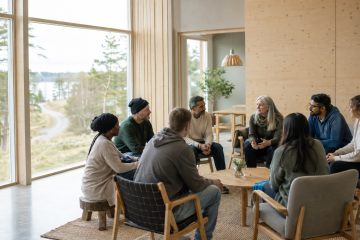
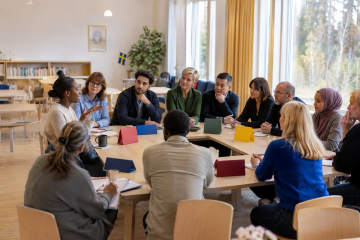
One particularly promising solution is intergenerational cooperation, where younger people help older generations develop digital skills while simultaneously strengthening their own sense of responsibility and communication abilities. Research shows that adapting to new technologies among older age groups rarely happens automatically. Simply providing apps, digital services, or learning opportunities is insufficient—what truly matters is creating learning environments that allow people to build confidence and use these skills independently.
Educational environments where different generations learn together can also play a significant role. One example is the Nordic folk high school model, where younger and older people study together, exchange experiences, and learn to understand different perspectives. Practical experience from such environments shows high effectiveness and strong approval from participants of all ages. These forms of collaboration help create a more conscious relationship with information and strengthen society’s ability to resist misinformation and digital manipulation as a whole.
In today’s digital society, misinformation is no longer simply a technological issue—it has become a challenge for society as a whole. Younger generations undoubtedly possess strong technical skills, adapt faster to new technologies, and move more naturally in digital environments. However, these advantages do not guarantee full protection against manipulation. Just like older generations, young people still have room to further develop critical thinking skills, improve their ability to verify information sources, and learn to process information more consciously.
With the right educational approach, continuous practice, and—perhaps most importantly—personal motivation to improve these skills, significant progress can be achieved. That is why society as a whole—schools, universities, governments, media organizations, and educational institutions—must continue investing in media literacy, protection against misinformation, and the development of critical thinking skills among people of all ages. Only then can we build generations capable not simply of consuming information, but of consciously analyzing it and making independent decisions in an increasingly complex digital world.
Autor: Alexandra Svensson, Sweden

0 Comments