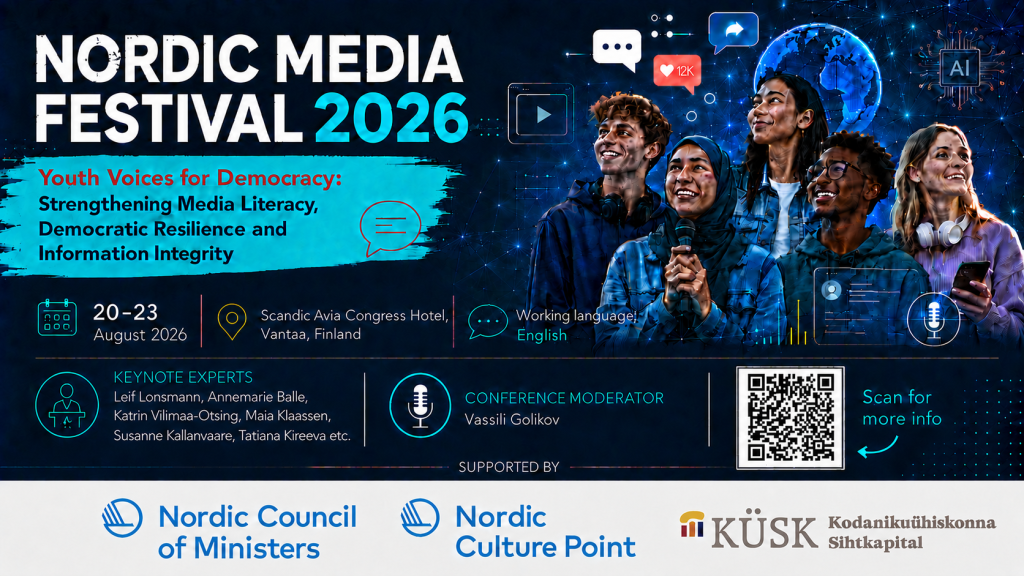
Nordic Media Festival 2026
Youth Voices for Democracy: Strengthening Media Literacy, Democratic Resilience and Information Integrity
20–23 August 2026
Scandic Avia Congress Hotel, Vantaa, Finland
Working language: English
The Nordic Media Festival 2026 will bring together young people, educators, journalists, media professionals, researchers, policymakers and civil society organisations from across the Nordic-Baltic region to explore how young people can strengthen media literacy, critical thinking, digital resilience and democratic participation.
Today’s young people are growing up in a digital world shaped by artificial intelligence, social media algorithms, influencers, misinformation, information overload and rapidly changing technologies. The festival will focus on how young people can navigate these challenges responsibly while becoming active content creators, storytellers, fact-checkers, community leaders and contributors to democratic resilience.
The programme includes expert panels, youth dialogues, practical workshops, media skills sessions, meetings with media professionals and a digital exhibition of youth-produced media content. Participants will explore topics such as:
- media literacy and critical thinking
- AI, deepfakes and disinformation
- social media, influencers and civic participation
- digital wellbeing and cognitive resilience
- fact-checking and information integrity
- youth activism and democratic participation
- community journalism and positive media use
A key outcome of the festival will be the development and adoption of the Nordic Youth Media Manifesto—a youth-led document containing recommendations for strengthening media literacy, democratic participation, cognitive wellbeing and information resilience across the Nordic-Baltic region.
Festival agenda
20 August: Arrival, digital exhibition of youth media contributions and opening debates
21 August: Nordic Media Conference and co-creation of the Nordic Youth Media Manifesto
22 August: Practical workshops, media meetings and youth media activities
23 August: Presentation of outcomes, adoption of the Manifesto, conclusions and departures
Key message: Empowering young people to think critically, stay resilient, protect their cognitive wellbeing, navigate digital challenges responsibly and actively contribute to democratic and inclusive societies.
21 August 2026 – Conference Day
09:30–10:00 Registration and Networking
10:20–11:00 Official Opening Remarks
10:25–10:15 Keynote Speakers
- Leif Lønsmann, Nordic Journalist Centre
- Maia Klaassen, University of Tartu
10:15–11:30 Panel I: “Growing Up in the Digital Age: Youth, Identity and Cognitive Wellbeing”
The panel will explore how the contemporary digital environment affects young people’s identity, attention, emotional wellbeing and resilience.
Key topics:
- information overload and the attention economy;
- social media and mental wellbeing;
- healthy digital habits and media consumption;
- online pressure and comparison culture;
- supporting young people’s cognitive and emotional resilience.
Moderator: Susanne Kallanvaare, Burgårdens Gymnasium, Sweden
Experts:
- Gregor Mataloja, Tallinn University, Estonia
- Albert Otkjaer, young journalist, Denmark
- Valeria Skaldina, Femina, Finland
- Daniel Rajala, Kurkelan School, Finland
- Anja Bjaereteg, Burgårdens Gymnasium, Sweden
11:45–13:00 Panel II: “Critical Thinking and Fighting Disinformation in the Age of AI”
The panel will examine how misinformation, propaganda and AI-generated content affect young people and democratic societies, and what practical skills are needed to strengthen information resilience.
Key topics:
- misinformation, disinformation and propaganda;
- AI-generated content and deepfakes;
- fact-checking and source-verification skills;
- media literacy as a democratic competence;
- strengthening young people’s information resilience.
Moderator: Leif Lønsmann, Nordic Journalist Centre
Experts:
- Annemarie Balle, Folkevirke and independent journalist, Denmark
- Katrin Vilimaa-Otsing, marketing trainer and AI expert, Estonia
- Tatjana Kireeva, journalist, Sveriges Television, Sweden
- Marko Krapu, executive producer of YLE, Finland
- August Østergaard Nilsson, journalist, Denmark
13:00–14:00 Lunch
14:00–15:00 Panel III: “Social Media, Influencers and Civic Participation”
The session will discuss how young people, influencers a nd digital opinion leaders can use social media responsibly to support civic participation, constructive dialogue and positive social impact.
Key topics:
- the influence of content creators and digital opinion leaders;
- responsible influence and ethical communication;
- youth activism and civic engagement online;
- using social media for positive social impact;
- building trust and dialogue in digital communities.
Moderator: German Morris, Estonia
Experts:
- Karina Reisel, Tallinn Technical High School, Estonia
- Ingrid Raudsepp, Möllans Basement, Sweden
- Ivan Vasilevskikh, Compass, Denmark
- Venla Lehto, Tampereen Yhteiskoulun Lukio, Youth coordinator of Green Habito, Finland
15:00–15:15 Introduction to Working Groups
Participants will receive instructions, form cross-national groups and identify the main questions for discussion.
15:15–16:30 Youth Working Groups: “Youth Voices and Democratic Resilience: Preparing for Future Challenges”
Young participants will discuss and formulate recommendations for the Nordic Youth Media Manifesto.
Working-group themes:
- youth perspectives on democracy and participation;
- democratic resilience in uncertain times;
- polarisation and social cohesion;
- community engagement and local action;
- responsible media use and information integrity.
Moderators: National delegation leaders
16:30–17:00 Summary and Presentation of Key Recommendations
The working groups will present their main conclusions and proposals. The recommendations will be consolidated for inclusion in the Nordic Youth Media Manifesto.
19:00–20:00 Dinner
Key conference message
Empowering young people to think critically, remain resilient, protect their cognitive wellbeing, navigate digital challenges responsibly and contribute actively to democratic and inclusive societies.
22 August 2026 – Youth Media Skills and Digital Activism Lab
Time: 10:00–13:10
Venue: Scandic Avia Congress Hotel, Vantaa
Target group: Young people aged 14–30, youth leaders, young content creators, media activists and journalists
Main objective
To strengthen young people’s practical ability to assess digital content critically, create trustworthy and engaging media, communicate responsibly online and use digital platforms for positive civic and community action.
Expected learning outcomes
Participants will learn to:
- recognise misleading, manipulative and AI-generated content;
- apply basic fact-checking and source-verification methods;
- create short media content for civic and social campaigns;
- develop clear messages for different audiences;
- use social media responsibly for youth participation;
- apply principles of ethical communication, digital wellbeing and information integrity.
10:00–10:15 Opening and Digital Activism Challenge
- Introduction to the objectives and working methods.
- Participants will discuss the question: “What makes online content trustworthy, engaging and worth sharing?”
The activity will identify key digital challenges, including misinformation, algorithms, information overload, polarisation and pressure to respond quickly.
10:15–11:00 Workshop 1: “Verify Before You Share: Fact-Checking and AI Content Detection” – Katrin Vilimaa-Otsing
Participants will evaluate sample social media posts, headlines, images and AI-generated materials.
They will practise:
- checking original sources and their publication context;
- distinguishing facts, opinions and emotional manipulation;
- using reverse image searches and verification tools;
- recognising warning signs of deepfakes and AI-generated content;
- comparing information across reliable sources;
- applying a practical verification checklist.
Output: Each team prepares a short fact-check assessing whether a selected claim is trustworthy, misleading or false.
11:00–11:10 Break
11:10–12:00 Workshop 2: “Create for Change: Digital Storytelling and Community Journalism” – Tatjana Kireeva, SVT
Participants will learn how to transform a local or social issue into a clear and human-centred media story.
The workshop will cover:
- identifying a relevant issue;
- defining the target audience;
- developing a strong key message;
- using interviews, personal stories and visuals responsibly;
- avoiding sensationalism and stereotypes;
- ensuring that diverse voices are represented.
Teams may choose themes such as media literacy, youth participation, mental wellbeing, sustainability, inclusion or social cohesion.
Output: Each group creates a storyboard or script for a video, reel, podcast, photo story or social media post.
12:00–13:00 Workshop 3: “From Post to Participation: Designing a Youth Digital Activism Campaign” – German Morris, PCE
Participants will develop a small digital campaign focused on meaningful participation and positive community action.
Each team will define:
- the issue to be addressed;
- the desired change;
- the target audience and relevant stakeholders;
- appropriate digital platforms and formats;
- a campaign slogan and call to action;
- ethical and online safety considerations;
- indicators for measuring reach and engagement.
Output: Each team prepares a one-page campaign concept and one example of digital content.
13:00–13:10 Presentations, Peer Feedback and Next Steps
Teams will briefly present their fact-checks, media stories or campaign concepts.
Feedback will consider:
- clarity of the message;
- credibility and evidence;
- creativity;
- inclusiveness;
- potential social impact;
- realistic next steps.
Selected outputs may be included in the festival’s youth media exhibition, shared through project communication channels or developed further as contributions to the Nordic Youth Media Manifesto.
13:10–14:30 Lunch
15:30–17:00 Study Visit and Practical Media Work in Helsinki
Participants will visit Yle to learn about public-service media, journalism, content production, professional media standards and the role of trusted media in democratic society.
18:00–20:00 Dinner and Informal Networking
The evening will provide space for participants, experts and national delegations to exchange experiences, discuss future cooperation and develop new cross-border media initiatives.
More information: info@sscw.ee / feminasuomi@gmail.com
A key outcome of the festival will be the development and adoption of the Nordic Youth Media Manifesto – a youth-led document with recommendations for strengthening media literacy, democratic participation, cognitive wellbeing and information resilience across the Nordic-Baltic region.