The word “uncertainty” has ceased to be an abstract concept in today’s world. Technological
revolutions, economic turmoil, environmental challenges, and geopolitical shifts have turned our lives
into a never-ending marathon on a constantly changing track. In this environment, old maps — such as
formal degrees earned in our youth — are no longer enough to navigate the future. What matters
increasingly is a person’s ability to adapt, retrain, and find a sense of stability within themselves. This is
where non-formal education, and the Swedish folkhögskola (folk high school) in particular, becomes
more than just an educational model. It becomes a social anchor and, for many people, a genuine
second chance.
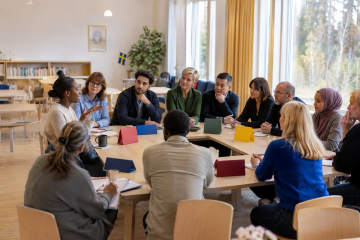
So, what is a folk high school? In many ways, it is the opposite of a traditional school. There are
no conventional grades, no fear of failing an exam, and no rigid attachment to a national curriculum.
Education here is not primarily about earning a certificate or diploma, but about the person themselves
— their personal development, civic engagement, confidence, and practical skills. In times of crisis, this
model becomes particularly valuable, revealing itself through four key principles: second chances,
lifelong learning, flexibility, and creativity. Behind each of these theoretical concepts, however, are real
people and their stories. It is these experiences, more than any definition, that show why the system
works.
First and foremost, folk high school is a place for a “second chance.” In a world where economic
crises can push even experienced professionals to the margins and migration can force people to start
their lives from scratch in a foreign country, the psychological impact of failure can become one of the
greatest obstacles. Traditional education, built around competition and comparison, can sometimes
reinforce this feeling by reminding people of what they have not achieved. In a Swedish folk high school,
the learning environment is free from traditional grading. The teacher is not a controller or examiner,
but a mentor. A student can return to mathematics at the age of 40, learn Swedish as a refugee, or
receive their first upper-secondary qualification later in life. Most importantly, they do not have to be
afraid of making mistakes. In times of uncertainty, this experience of starting over can give a person
something essential: confidence in their own abilities and the feeling that their future is still in their
hands.
People come to a folk high school for a second chance, and sometimes even a third. Every
student arrives with their own goals and works towards them with the support of teachers and
classmates. I have been fortunate enough to work as a teacher in a school based on the principles of
non-formal education, and after a little more than two years there, I have seen how people can change.
This approach to education does not only transform students; it also challenges teachers to think
differently and find an individual approach to each person.
There is no traditional grading system at a folk high school, and teachers do not expect
immediate results. Sometimes what students need most is space and time — the opportunity simply to
get used to being in an environment where they are not judged or compared with others. Genuine care,
respect, and, quite often, an individual approach can gradually produce remarkable results. It may begin
with something small, such as arriving on time for a lesson, and eventually lead to a first trip abroad,
successfully completing final examinations, or being accepted into a desired field of study.
For those who come to school later in life, the social side of education can be just as important
as the academic one. Schools organise exhibitions and meetings with artists, lectures on everything from
politics to archaeology, concerts, theatre performances, class trips, activities involving different groups,
and a wide range of extracurricular events. People who came looking for an escape from boredom or
loneliness can find exactly that — a community and a sense of belonging.
It seems to me that one of the most important things students take with them when they leave
is an inner sense of stability. Young people become less afraid of failure and gain the courage to try,
because they begin to understand that a mistake in this kind of educational environment is not a verdict.
It is simply another stage of learning — something everyone goes through.

The second pillar of the system is the philosophy of lifelong learning. In an era when knowledge
becomes outdated faster than we can take notes, education cannot realistically end at the age of 25.
Folk high school integrates learning into everyday life. Age is not necessarily a barrier: in the same
group, a recent school graduate can sit alongside a grey-haired engineer who has decided to try
something completely new. Education becomes not simply one stage of life, but a continuous part of it.
Short courses, intensive summer programmes, and evening classes allow people to “refuel” their
knowledge gradually, without having to put their careers on hold or sacrifice family life. In this sense,
folk high school teaches us to see change not as a catastrophe, but as a natural reason to begin another
chapter of learning.
The third aspect is flexibility and choice. In an unstable world, there are no universal solutions,
and folk high schools offer people different paths depending on their needs and goals. Students can
choose between general academic preparation for further studies, vocational and creative courses —
from journalism to traditional crafts — or intensive integration programmes for newcomers. Many
courses can also be combined with work, while the learning process can be adapted to a student’s
existing level of knowledge. This gives people a sense of control over their own lives. Instead of simply
adapting to abstract educational requirements, they have more freedom to decide when, how, and
what they want to learn. For someone who has already experienced a major change in life, this freedom
can be especially important.
Finally, perhaps one of the most important skills for the future is creative thinking. In the age of
artificial intelligence, algorithms are increasingly capable of solving standardised and repetitive tasks.
What remains uniquely valuable is the ability to see things differently: to think outside established
frameworks, follow intuition, connect seemingly unrelated ideas, and find solutions where there is no
obvious answer.
At a folk high school, creativity is not an optional extra; it is woven into the educational
approach itself. Instead of relying exclusively on traditional lectures, teachers often use dialogue-based
learning, where knowledge emerges through discussion and group work. Instead of abstract exercises,
students can work on projects connected to real issues and needs within local communities. This
encourages them to look for alternative solutions rather than simply follow familiar paths. When the
world disrupts old patterns and expectations, this kind of thinking can help people avoid becoming
paralysed by uncertainty. Instead, they can learn to recognise new possibilities within situations that
initially seem chaotic. At the same time, despite all the advantages of this approach, it is important to
recognise that people have different needs, personalities, and learning habits. For some, a more
traditional and structured educational system may be exactly what they need to reach their goals.
Others may thrive when given greater freedom and flexibility. There is no single educational model that
works equally well for everyone.
The Swedish folk high school is therefore much more than an educational institution. It offers an
alternative path for people who may not fit comfortably into the traditional education system. It is built
on flexibility, trust, and a strong belief in the potential of the individual. In a world where many of the
structures we once relied on are becoming less predictable, folk high school teaches us something
fundamental: even when the outside world is uncertain, we can develop our own sense of stability if we
learn how to start again — without fear, without being defined by grades, and without age becoming a
limitation. Perhaps this is one of the most important skills for life today: not simply to teach a person
something, but to help them find their own way and discover who they can become in a constantly
changing world.

Author: Ingrid Raudsepp, Sweden

Categories: Uncategorized

0 Comments

Leave a Reply

Avatar placeholder

Your email address will not be published. Required fields are marked *